ANCIENT HELIKE
The Lost Capital City of Aigialeia Returns to Light
Modern-day Aigialeia preserves the ancient name of the region, used before it was renamed Achaea following the settlement of the Achaeans at the end of the Mycenaean period (11th century BC). On its fertile soil, the city of Helike was founded as early as the prehistoric era (14th century BC); it rose to become the capital city of the Ionian —and later the Achaean— Dodekapolis (League of Twelve Cities). The city owes its name to Princess Helike, daughter of the local Aigialean king Selinous and wife of Ion, the leader of the Ionians. This significant city, described as “wide” in Homer’s Iliad, participated in the Trojan War under the command of King Agamemnon of Mycenae, contributing ships to the campaign. The great poet refers to Helike and the presence in its region of the “holiest” sanctuary of the Ionians (according to Pausanias), the sanctuary of Helikonios Poseidon, where festivals known as the “Panionia” were held in the god’s honor and where all Greeks dedicated “many and beautiful gifts.”
Helike’s undisputed pre-eminence among the Achaean cities remained unshaken for at least a millennium —until the early decades of the 4th century BC, when, in the winter of 373 BC, it was struck by a major natural disaster. A powerful earthquake and a massive inundation from the sea (tsunami) resulted in submergence of a large part of the city and the deaths of most of its inhabitants. This dramatic catastrophe, which occurred just a decade before Plato wrote his dialogues on mythical Atlantis, is believed to have inspired the philosopher’s description of that legendary land’s disappearance. Thus, the search for Helike began early on, driven by the hope of bringing to light a “second Pompeii” —a comparison first made by the late archaeologist Spyros Marinatos, who initiated the first organized efforts to locate the lost city in the mid-20th century. However, the investigations focused on the underwater area and concluded in 1972 without yielding concrete results.
The search for Helike was subsequently abandoned, and no interest was shown by any organization until September 1988, when a new interdisciplinary effort was launched under the auspices of the American School of Classical Studies at Athens, the University of Patras, and the Helike Society; the project was initiated and directed by archaeologist Dora Katsonopoulou, —for whom the search for Helike was a lifelong mission— with the active participation of the renowned American physicist and geoarchaeologist Steven Soter. This new research effort adopted a different approach to the issue, employing modern technology and an innovative methodology that combined geosciences with archaeological excavation; this resulted in the successful location of the ancient city on land —specifically in the area of the modern villages of Eliki, Rizomylos, and Nikolaiika— rather than at sea, as had previously been mistakenly believed. A pivotal factor in the discovery’s success was a new interpretation by Dora Katsonopoulou of the account given by the philosopher and mathematician Eratosthenes (3rd century BC), who had visited the site and spoken with its inhabitants.
Systematic research and excavations by the Helike Project have brought to light findings that shed light on the circumstances surrounding the ancient city’s destruction and reveal the history of Ancient Helike, spanning an unbroken period of 3,500 years from the 3rd millennium BC through to the 5th century AD. At Rizomylos, the team uncovered a unique proto-urban center of ancient Achaea (2500–2100 BC), featuring paved streets and spacious buildings with their impressive room contents preserved intact. Among the rich array of finds, a rare elite drinking vessel stands out —the type known from Homer as the depas amphikypellon. Significant finds at Nikolaiika date back to the period when Ancient Helike reached its peak, a time when it established the most famous Achaean colony in Southern Italy, the renowned Sybaris. A unique discovery is the “leophoros (highway)” traversed by the traveler Pausanias in the 2nd century AD, located in the Helike plain between Eliki-Rizomylos-Nikolaiika, preserved in an impressive length of 1,300 meters; this is a large-scale feat of transport and communications engineering for the northern Peloponnese.
The unexpected discovery of the “reborn” Helike following the earthquake of 373 BC
Dora Katsonopoulou and her team, however, also discovered a previously unknown settlement in the area of modern-day Eliki; this discovery overturns the long-held view that the city vanished from the face of the earth after the catastrophic earthquake of 373 BC. The uncovering of buildings and a cemetery across an extensive area indicates that there were survivors of the disaster and that, within a short time —by the mid-4th century BC— a new settlement had developed on the western side of the Helike plain, bordering Aigion. The new Helike, reborn from its ruins, sought to maintain its leading position within the Achaean League, just as before; it even minted coins depicting its patron god, Poseidon, along with his symbols, the trident and dolphins. However, the political and economic weakness it faced after the earthquake, enabled neighboring Aigion to take its place at the helm of the League.
The unique ancient textile workshop at Helike
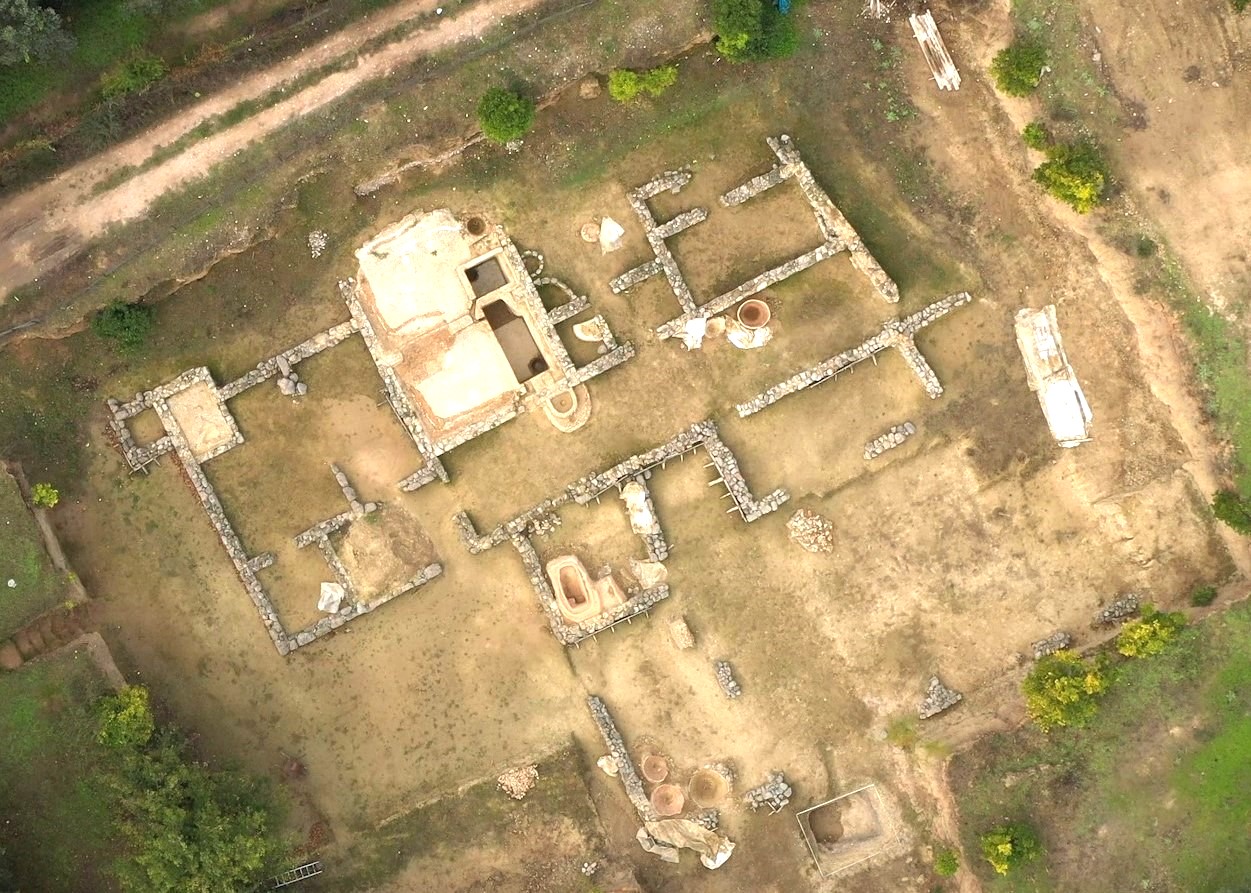
Among the buildings of the revived settlement, a large complex stands out as a facility for dyeing and textile production —a find unique of its kind in the western Mediterranean basin. The section of the building excavated to date covers an area of over 1,000 square meters and preserves its technical installations in excellent condition, including a complex of four tanks with carefully made pebble floors, immersion baths, clay hearths, clay structures for washing and cleaning activities, storage areas featuring impressively large pithoi (storage jars), and living quarters. A wealth of portable artifacts was recovered from the building’s spaces and rooms, including a large number of vessels, numerous coins from cities across the ancient Greek world, various metal objects, terracotta lamps, and clay weaving implements, as well as rarer finds such as beads made of semi-precious stones and precious metal, and a terracotta Tanagra figurine. The Helike workshop —along with others of the same period— forms part of a network of ancient textile workshops around the Corinthian Gulf; it features large-scale facilities and is the best-preserved of them all. Its privileged location, as the only coastal workshop in the network, secured it a key role in the region’s economy and trade.